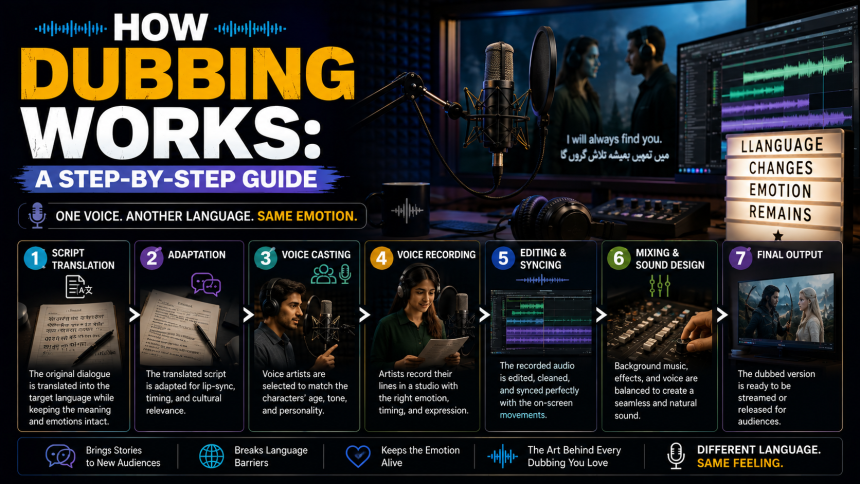
Ever wondered how a film shot in one language ends up sounding completely natural in another? Behind every good dub is a careful, multi-stage process. Here is how professional dubbing works, step by step.
- Step 1: Translation and Adaptation
- Step 2: Casting Voice Actors
- Step 3: Recording in the Studio
- Step 4: Lip-Sync and Timing
- Step 5: Mixing and Mastering
- Why It Takes a Team
- Frequently Asked Questions
- How long does it take to dub one episode?
- Do voice actors watch the original while recording?
- What is lip-sync in dubbing?
- Related Reading
Step 1: Translation and Adaptation
First, the original script is translated — but a literal translation rarely works. A skilled adapter rewrites lines so they carry the same meaning while fitting the timing and lip movements of the on-screen actors. This balance between accuracy and natural flow is an art in itself.
Step 2: Casting Voice Actors
The dubbing director casts voices that match each character’s age, personality, and emotional tone. A good vocal match makes audiences forget they are hearing a different actor entirely.
Step 3: Recording in the Studio
Voice actors record their lines in a soundproof booth while watching the original footage. They perform line by line, matching emotion and pace, often repeating takes until the delivery is perfect.
Step 4: Lip-Sync and Timing
Engineers and actors fine-tune each line so the words align with the characters’ mouth movements. This is one of the hardest parts — tiny adjustments make the difference between believable and awkward.
Step 5: Mixing and Mastering
Finally, the new dialogue is mixed with the original music and sound effects, balanced for volume and clarity, and mastered into the final track. The result should sound as rich as the original.
Why It Takes a Team
Translators, directors, actors, and sound engineers all collaborate closely. Each episode can take many hours of careful work, which is why professional dubs sound so much better than amateur ones.
Frequently Asked Questions
How long does it take to dub one episode?
It varies, but a single episode can take many hours to days, depending on length, number of characters, and the quality standard.
Do voice actors watch the original while recording?
Yes. They watch the footage so they can match emotion, pace, and lip movements line by line.
What is lip-sync in dubbing?
Lip-sync is the process of timing the new dialogue so it aligns with the on-screen actors’ mouth movements, making the dub look natural.
Related Reading
- What Is Dubbing? A Complete Beginner’s Guide
- How to Write a Dubbing Script
- Voice Over vs Dubbing vs Narration: Clear Differences
- How to Become an Urdu Voice-Over Artist: A Roadmap
Written by the UrduDub editorial team. We cover dubbing, voice-over, and where to watch localized content through official, legal sources. Spotted an error? Contact us — see our Editorial Policy.